

Key Takeaways
- The trust crisis is structural, not just cyclical. Populism, media disintermediation, and content volume have combined with AI to create a buyer environment defined by scepticism and overwhelm.
- AI is a powerful enabler of authenticity, not its enemy. Used correctly, it amplifies real human voices. Used lazily, it accelerates brand damage.
- Humans in, humans out. The most useful frame for AI content: genuine human input at the start, genuine human review at the end. Everything in between is acceleration, not substitution.
- Experience beats digital nativeness. Older practitioners are often better AI users than younger ones, because critical judgment takes years to develop and AI needs someone who knows what good looks like.
- Buyers have decided before you know they exist. The dark funnel is real. The influence you build has to work even when no one's raising their hand or liking your posts.
- People buy into brands, not from them. The faceless AI brand doesn't build the kind of trust that closes complex deals. Founder stories, employee voices, and customer advocacy are the moat now.
- Outbound email is on life support. AI-amplified spray and pray is accelerating brand damage, not pipeline. Every bad cold email is a trust withdrawal you'll pay for later.
Part 1. The Four Pillars of the B2B Trust Crisis
<iframe src="https://www.veed.io/embed/5efc975a-f35e-40f3-9cd0-6714d64e95a6?watermark=0&color=&sharing=0&title=0" width="744" height="504" frameborder="0" title=" May 2026 Joel Harrison Part 1" webkitallowfullscreen mozallowfullscreen allowfullscreen></iframe>
Joel has been thinking seriously about trust for years, originally as research for a book on thought leadership. What he found was that trust isn't eroding for one reason: it's a convergence of four forces hitting at once. First, political populism has normalised the active derision of experts and traditional authority, and that filters down through all of society. Second, B2B media properties that once acted as trusted gatekeepers have lost their dominance: fewer people's lives are shaped by a handful of authoritative publications. Third, business decision makers are simply overwhelmed: hundreds of emails, hundreds of ads, no clear signal to cut through the noise. And then, layered on top of all of that, AI has made average content instantaneous and free.
Key Insight: The content avalanche isn't a recent problem, but AI turned a snowstorm into a climate event: the question for buyers is no longer "what do I read?" but "what on earth can I trust?"
Part 2. Humanising Is the Antidote But You Have to Mean It
<iframe src="https://www.veed.io/embed/b424904d-1ef4-4b62-8079-b44c97fc2d8d?watermark=0&color=&sharing=0&title=0" width="744" height="504" frameborder="0" title="May 2026 Joel Harrison Clip 2" webkitallowfullscreen mozallowfullscreen allowfullscreen></iframe>
Joel is clear that humanising isn't a trend, it's the strategic response to everything described in Part 1. His own move from running B2B Marketing as an organisation to being a solo content creator was a deliberate bet on this: put your own voice first, express real opinions, bring personality to things. His B2B Matrix of Influence frames this systematically: thought leadership, influencer marketing, customer advocacy, and employee advocacy are all human strategies that cut through in ways automated content cannot. The risk, Chris notes, is what Phil at Giraffe Social called "lazy AI" - content that is technically competent but, in Joel's words, humanly inert.
Key Insight: Humanising only works when there is actually a human behind it. Audiences are getting better, not worse, at telling the difference.
Part 3. Can AI Ever Be Authentic? Humans at the Start and End
<iframe src="https://www.veed.io/embed/533271ac-c878-4a99-8876-ec46402b1969?watermark=0&color=&sharing=0&title=0" width="744" height="504" frameborder="0" title="May 2026 Joel Harrison part 4" webkitallowfullscreen mozallowfullscreen allowfullscreen></iframe>
This is the core question of the session, and Joel's answer is a qualified yes. AI cannot do things alone, but if humans are at the start and end of the process, it can be a genuine enabler of authenticity. Joel's own workflow is instructive: Claude writes his articles, but only based on his podcast conversations, and only after he works through them carefully to make sure they sound like him. The time savings are enormous; the authenticity is maintained because the raw material is his. The risk is when people without experience let AI produce the finished article unchecked. Joel flags something counterintuitive: Gen X and older millennials are often better at using AI than digital natives, precisely because they have the critical judgment to know when to push back on the output.
Key Insight: AI augments authentic voices; it doesn't create them and you can't outsource the judgment to know when the output has crossed from acceleration into impersonation.
Part 4. The Dark Funnel and the Changing Shape of the B2B Buyer
<iframe src="https://www.veed.io/embed/a880c33d-6c0b-4400-99de-53c38641ae50?watermark=0&color=&sharing=0&title=0" width="744" height="504" frameborder="0" title="May 2026 Joel Harrison clip 4" webkitallowfullscreen mozallowfullscreen allowfullscreen></iframe>
For the first time, the majority of B2B decision makers are millennials and Gen Z. Their research habits are different: they don't want to talk to a sales rep, they don't want to be visible, and by the time they raise their hand they've already built their shortlist. Joel's view is that buyers will care less over time about whether content was AI-generated, but the authenticity dimension will remain critical at the positioning and branding stage, where people buy into what an organisation stands for, and at the decision stage, where customer advocacy does the work that no automation can replicate. The stories of individual employees and customers are extraordinarily powerful precisely because they cannot be faked.
Key Insight: If you're not on the buyer's shortlist before they come looking, you're not getting a look in, and you only make that list by being consistently visible and credible in the dark, long before any conversation starts.
Part 5. The Avatar Conundrum: Where Synthetic Video Works (and Where It Doesn't)
<iframe src="https://www.veed.io/embed/47b55868-53e8-4b2e-a6ef-2300101b874d?watermark=0&color=&sharing=0&title=0" width="744" height="504" frameborder="0" title="May 2026 Joel Harrison clip 5" webkitallowfullscreen mozallowfullscreen allowfullscreen></iframe>
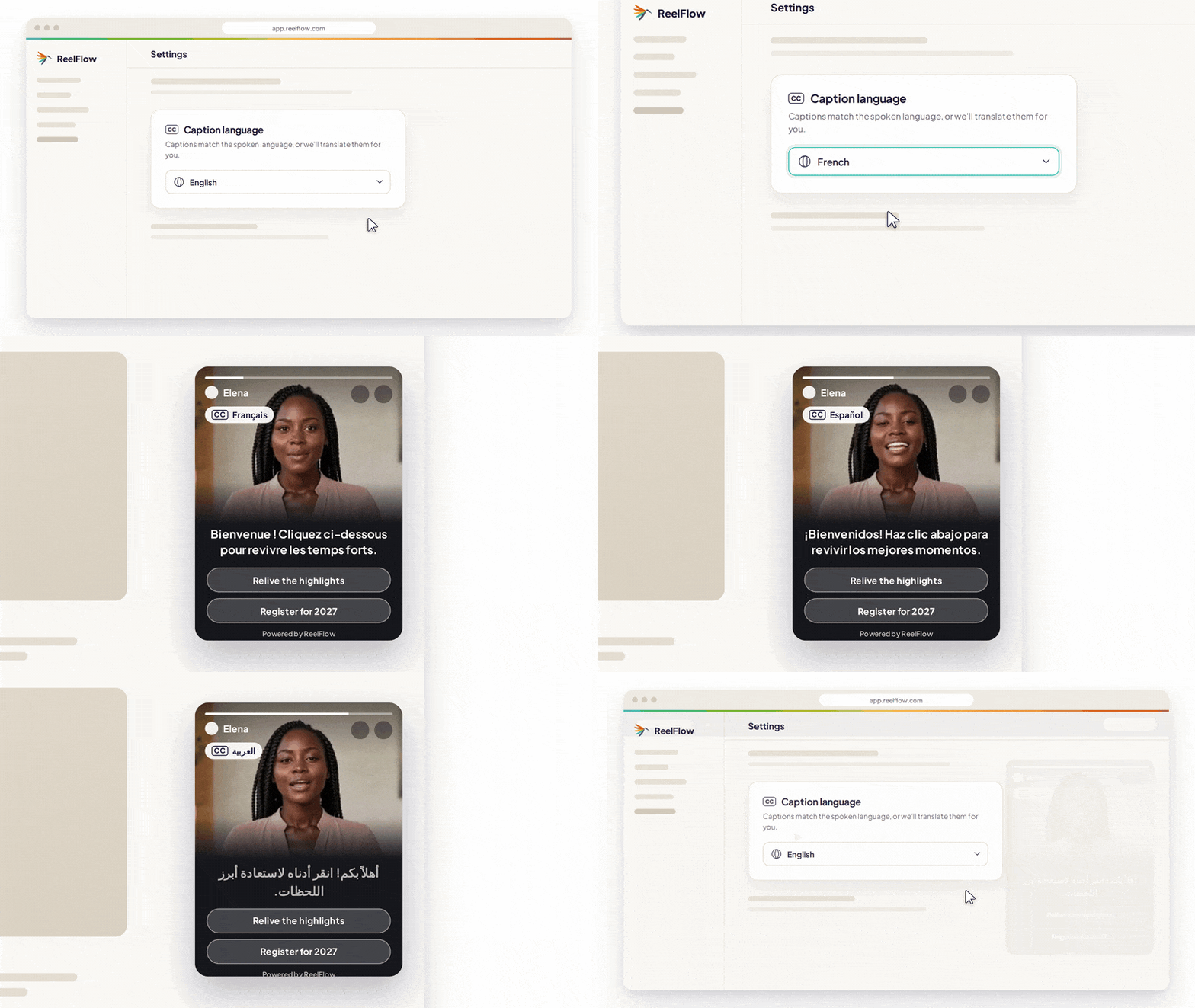
Chris raises something ReelFlow genuinely wrestles with: AI video models trained on a real person can now produce a convincing video in minutes, without the lighting rig or the scheduled recording session. Is that authentic? Joel's answer is that the determining factor is taste, ethics, and context, not a hard rule. His best-case scenario is the senior expert who is extraordinarily in demand: you take their one recording day and scale it, as long as there's transparency somewhere in the presentation. He sees a clear use case in professional services, where tactical thought leadership is already popular. The synthetic avatar on a homepage, though, is a different thing: Chris is sceptical that it builds trust at the buying stage, and Joel agrees that for meaningful B2B transactions, you need something behind the brand that's credibly human.
Key Insight: Scaling a real expert's reach through AI video is a legitimate strategy; substituting a manufactured synthetic for genuine human presence is a different bet entirely, and one the B2B market hasn't endorsed.
Part 6. Who's Doing This Well: People Front and Centre
<iframe src="https://www.veed.io/embed/3f9a7505-9c49-416c-a9da-8eb9e8e4b4c1?watermark=0&color=&sharing=0&title=0" width="744" height="504" frameborder="0" title="May 2026 Joel Harrison clip 6" webkitallowfullscreen mozallowfullscreen allowfullscreen></iframe>
The clearest pattern Joel and Chris see in the companies getting this right is consistent: they are putting real people at the heart of their marketing. Founders, execs, C-suite voices on LinkedIn. Employee content that outperforms company page content by multiples. Customer advocacy at the decision stage. Chris flags another dimension: the best brands are joining their social personality to their website experience. The visitor who's been following you on LinkedIn and arrives on your site should find the same people, the same voice, the same story, not a jarring switch to a faceless corporate brochure. Joel's framework for this is simple: people buy into brands, not from them. The face of a faceless automaton doesn't build the trust that closes a complex, multi-stakeholder deal.
Key Insight: Your people are your moat now - the founder story, the employee voice, and the customer testimony are the things your competitors cannot clone the way they can clone your product features.
Part 7. Outbound Email, Brand Damage, and What Haste Costs You
<iframe src="https://www.veed.io/embed/316614e6-e31e-46cd-80a8-4f63c1a9407c?watermark=0&color=&sharing=0&title=0" width="744" height="504" frameborder="0" title="May 2026 Joel Harrison clip 7" webkitallowfullscreen mozallowfullscreen allowfullscreen></iframe>
Both Chris and Joel are direct on this: AI-amplified cold email is a trust machine running in reverse. Chris checks his inbox and sees 5,000 unread cold emails in 18 months. Joel responds to automated outreach out of habit, gets an out-of-office bounce, and realises there's no human at the end of it. Chris was pitched on LinkedIn as the CEO of a company he sold in 2019. The data-in problem, the deployment problem, and the tone problem are all compounding each other. Joel's verdict: you do something with haste, you repent at leisure.
Key Insight: Every bad cold email is a brand withdrawal: cheap to send, expensive to recover from, and in an AI-amplified world the volume of withdrawals is happening faster than most teams realise.
Summary
The conversation Joel and Chris have here is about what happens to trust when the floor on content creation drops to zero. Joel's argument is that the structural forces (political, media, informational) were already in motion before AI arrived. AI has simply removed the last friction that was holding back the mediocre. The antidote isn't to stop using AI: Joel uses it every day and couldn't do his work without it. The antidote is to ensure that real people, real opinions, real experiences, and real judgment are the raw material that AI is working with. Buyers in complex deals will always want to know there's a real team behind a product. The dark funnel rewards consistent, authentic visibility over time. And the companies winning right now are the ones who have figured out that their people, not their product, are the thing competitors can't copy.