Key Takeaways
- The event website has a 365-day job: For the 363 days a year the show isn't running, the website is the other place where the event and its community come together.
- Your website is the one video channel you control: Social platforms will always own the experience, but on your own domain you control the brand, the quality and the journey.
- The highlights video is a starting point, not a strategy: A 90-second showreel buried in an embedded YouTube player sends people back to YouTube, not deeper into your site.
- Faces on forms create warmer leads: Commercial teams tell Chris that prospects arrive on calls saying they feel like they've already spoken, because they saw the salesperson on video first.
- Building it yourself gets you a fraction of the way: A home-brewed setup gets you 10, 15, maybe 20% of the way there, and the maintenance reality usually bites within six months.
- The dullest pages hold the biggest opportunity: Agendas, exhibitor lists, floor plans and awards pages are usually the driest content on the site, and the easiest to bring to life with short, human video.
- This is weeks of work, not a 12-month project: Customers have gone from planning to live in a couple of weeks, on their existing website.
Part 1. Buyers Have Changed. Most Event Websites Haven't.
<iframe src="https://www.veed.io/embed/363cac17-d7bb-4257-a239-7739ae55938b?watermark=0&color=&sharing=0&title=0" width="744" height="504" frameborder="0" title="Future of event websites - part 1 (blog)" webkitallowfullscreen mozallowfullscreen allowfullscreen></iframe>
Chris opened by zooming out. B2B audiences are researching differently, AI is reshaping search, more people sit on the committees that decide whether to exhibit or sponsor, and for the first time the majority of business decision-makers are millennials and Gen Z. Video is already the web's most popular content format, and over the last year Chris has seen event marketers move from wanting more video to wanting real people on camera: the faces behind the event brand telling its story.
Key Insight: The industry is packed with people buyers want to hear from; the event website is the place to put them in front of the camera.
Part 2. Your Website Is the One Video Channel You Actually Own
<iframe src="https://www.veed.io/embed/c1ef2598-a999-4d44-b359-dd64fc9bc9c6?watermark=0&color=&sharing=0&title=0" width="744" height="504" frameborder="0" title="Future of event websites - part 2 (blog)" webkitallowfullscreen mozallowfullscreen allowfullscreen></iframe>
Adam described his own buying behaviour: he no longer trawls through reviews, he goes to social to watch someone talk about the thing and wants that person to look and sound like him. Andy took that a step further. Social platforms are where people already watch video, but you don't control them. Your website is the one first-party touch point where you control the brand, the experience and the quality, and in a world where so much research now happens in text and chat, video is the visual layer people still crave.
Key Insight: Social rents you an audience; your website is the only place you get to own the whole video experience.
Part 3. The Highlights Video Is a Starting Point, Not a Strategy
<iframe src="https://www.veed.io/embed/67d123b4-115d-4909-9f6e-b80a2e8ad2c1?watermark=0&color=&sharing=0&title=0" width="744" height="504" frameborder="0" title="Future of event websites - part 3 (blog)" webkitallowfullscreen mozallowfullscreen allowfullscreen></iframe>
Chris was clear that video on event websites isn't new. Most shows already have a 90-second highlights reel, but it's usually buried on a page in an embedded YouTube player, and when it ends, YouTube wants that visitor back on YouTube, not deeper into your site. The video that works is the short-form, authentic talking-head format people already respond to on social. Andy added the human angle: we're wired to respond to a face, and customers tell ReelFlow that visitors recognise people on the show floor after seeing them on the website.
Key Insight: A showreel tells people what your event looked like; a familiar face tells them why they should be there.
Part 4. Build It Yourself and You'll Get 20% of the Way There
<iframe src="https://www.veed.io/embed/4720c60e-d0c7-4780-98ef-6ded99b35888?watermark=0&color=&sharing=0&title=0" width="744" height="504" frameborder="0" title="Future of event websites - part 4 (blog)" webkitallowfullscreen mozallowfullscreen allowfullscreen></iframe>
Adam put the obvious challenge to Chris and Andy: plenty of teams will think they can just build this themselves. Andy's answer drew on his and Chris's years running event tech business Accrue, where they often heard the same thing, and watched the reality of maintenance, deployment and training catch up within six months, all on top of actually running an event. Chris added that ReelFlow has served over a million video impressions on event websites in the last few months, which is shaping what works and where. Adam's own view was that the advantage has shifted to the team behind the product: the strategy on where video goes, and the coaxing that gets a camera-shy colleague on screen.
Key Insight: The product gets video on the page; the guidance on where, when and who is what makes it work.
Part 5. Inside Widget Expo 2027: A Visitor Journey Led by a Human
<iframe src="https://www.veed.io/embed/961fa9d2-0fcd-4dfc-8420-6c530d563c3e?watermark=0&color=&sharing=0&title=0" width="744" height="504" frameborder="0" title="Future of event websites - part 5 (blog)" webkitallowfullscreen mozallowfullscreen allowfullscreen></iframe>
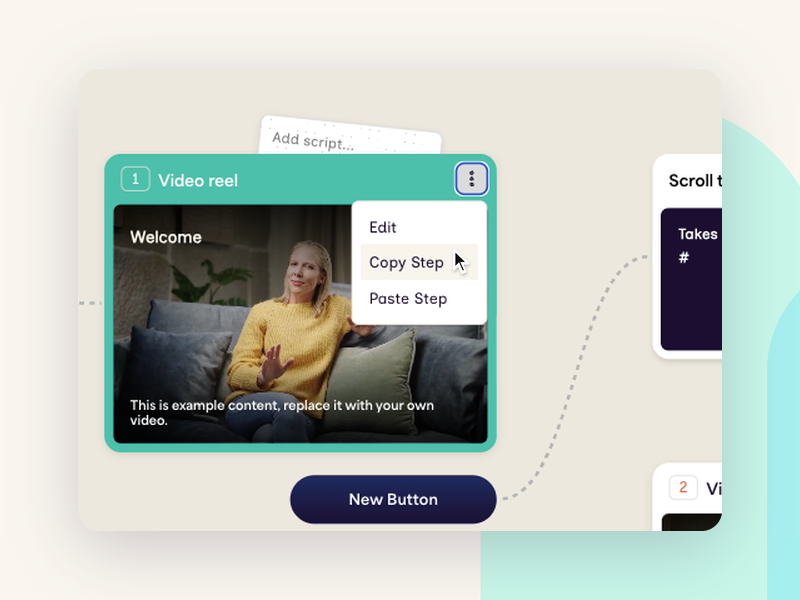
Chris walked through Widget Expo 2027, a fictional trade show website the team built as a playground for what's possible today (the presenters on it are AI-generated purely for the demo; ReelFlow's own advice is to use real people). The Overlay player acts as a concierge on the homepage: the show director welcomes you, asks whether you're an attendee or an exhibitor, then whether you're new or returning, and routes you to the right page. From there the Inline player takes over, explaining who you'll meet and walking you through pass types, with the page itself changing as you pick the VIP option. Andy noted it's responsive by default, so the mobile experience is just as strong, and Adam's takeaway was fewer clicks between interest and registration.
Example use-cases:
On the why exhibit page, the head of exhibition sales talks you through the audience and sponsorship packages while the whole page transforms around the video, all the way to the enquiry form, without you ever leaving the page. Chris shared what commercial teams keep hearing from people who come through this route: "I saw you in the video... I feel like we've already spoken." At a time when trust is at an all-time low, Adam summed it up as a properly warm lead. Andy stressed that the core is still a choose-your-own-adventure experience: visitors pick the topics they want to hear about rather than sitting through a video.
Agenda pages are boring, they don't have to be! Adam didn't hold back: most agendas are a session title, a description and a headshot, and unless you already know the speaker there's no personality behind it. He's keen to test speakers on video pulling attendees towards their sessions. Chris showed the same idea across the other dry pages: exhibitors recording 30 to 40 seconds on a phone or webcam to replace a grid of logos, a show director talking visitors around the zones of a floor plan, and awards pages with judges and last year's winners, often using footage teams already capture at the ceremony. Widget Expo 2027 will launch as a resource so teams can explore these use cases for themselves.
Key Insight: The pages your visitors skip are the ones that most need a human voice.
Part 6. This Doesn't Need To Be a 12-Month Project
<iframe src="https://www.veed.io/embed/697cc2c1-8509-461c-bc3b-6eb5f08dee13?watermark=0&color=&sharing=0&title=0" width="744" height="504" frameborder="0" title="Future of Event Websites - Part 6 (blog)" webkitallowfullscreen mozallowfullscreen allowfullscreen></iframe>
To close, Chris made the case that none of this requires a rebuild. Customers have gone live in a couple of weeks, covering planning, mapping out the Flows, scripting and video creation, and the Overlay player goes on an existing site with a single line of code. He laid out why it works on three levels: visibility, because Google and LLMs like video added in a way that exposes what's said in it; engagement, through lower bounce rates and longer, deeper visits; and conversion, which rises when the first two are done well. Andy's final word was for developers and marketers alike: it all works within existing CMSs and websites.
Key Insight: You don't need a new website to give your visitors a more human one.
Summary
The thread running through this conversation is that the event website has outgrown its brochure role. Buyers research on their own terms, trust is scarce, and the one asset an organiser fully controls is still mostly text. Chris, Andy and Adam kept coming back to the same answer: put the real people behind the show on the pages that matter, from the homepage welcome to the exhibitor enquiry form, and keep that site working all year round. If you want to see it in person, ReelFlow will be at Event Tech Live at ExCeL London in November, where Chris and Sam from EasyFairs will share how EasyFairs rolled it out across multiple shows.